There are no items in your cart
Add More
Add More
| Item Details | Price | ||
|---|---|---|---|
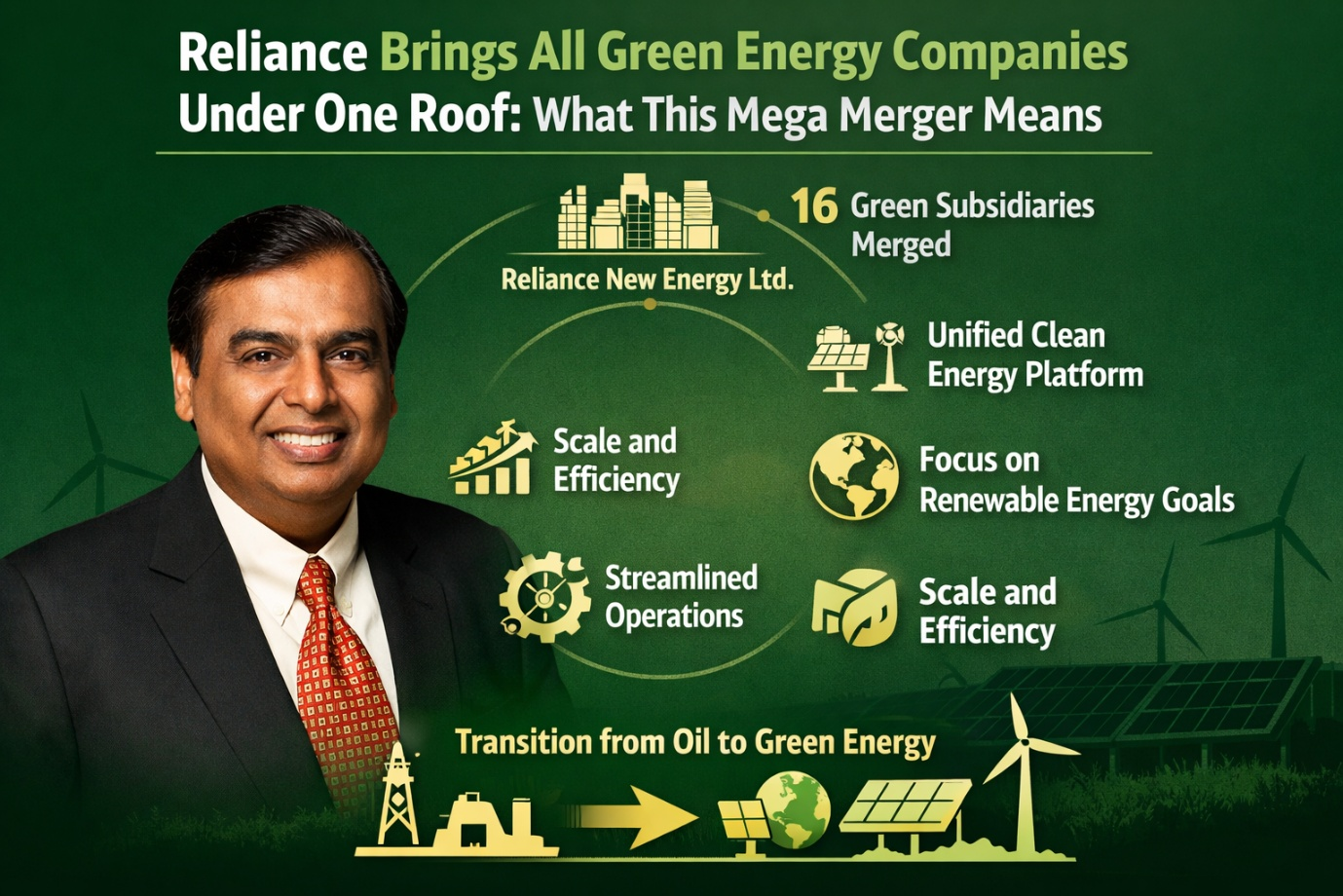
Mukesh Ambani's Reliance Industries has just completed a major housekeeping exercise in its clean energy business. On January 21, 2026, the company merged 16 separate green energy companies into one single entity called Reliance New Energy Limited. This move is part of Reliance's bigger plan to transform from an oil-dependent giant into a renewable energy leader.
Understanding Reliance Industries
Reliance Industries is India's biggest and most valuable company. Started by Dhirubhai Ambani decades ago, it's now run by his son Mukesh Ambani, one of the world's richest people. Most Indians interact with Reliance daily-whether it's filling petrol at a Reliance pump, using Jio mobile services, or shopping at Reliance retail stores. The company made its fortune in oil refining and petrochemicals. But in recent years, Mukesh Ambani has been clear about his vision: he wants Reliance to become a major player in clean, renewable energy. This latest merger is a concrete step in that direction.
The Merger Explained Simply
Imagine you run 16 different small businesses, each making one part of a car-one makes engines, another makes tires, another makes batteries, and so on. Managing 16 separate companies means 16 different offices, 16 sets of paperwork, and lots of coordination headaches. Now, if you merge them all into one car manufacturing company, everything becomes simpler and more efficient. That's exactly what Reliance has done with its green energy businesses. The 16 companies that got merged were working on different aspects of clean energy:
● Some were making solar panels and power electronics
● Others were focused on producing green hydrogen (a clean fuel of the future)
● Several were developing battery storage technology
● A few were working on fuel cells and infrastructure Companies with technical names like Reliance Power Electronics, Reliance Electrolyser Manufacturing, Reliance Green Hydrogen and Green Chemicals, and Reliance Hydrogen Fuel Cell are now all part of one unified company-Reliance New Energy Limited. Getting Government Approval
Any major corporate change in India needs government approval. The Ministry of Corporate Affairs, through its Regional Director for the Western Region, gave the green light for this merger. This ensures that everything is legal and follows proper procedures.
What It Means for Shareholders
If you own Reliance shares, this merger doesn't directly change your investment. Since Reliance already owned 100% of all 16 companies, this is essentially an internal reorganization-like rearranging furniture in your own house. However, there are some benefits:
Better Clarity: Instead of trying to understand what 16 different companies are doing, shareholders can now track one unified green energy business. This makes it easier to see how Reliance's clean energy plans are progressing.
Cost Savings: Running one company is cheaper than running 16. Fewer board meetings, less paperwork, reduced administrative costs-all of this improves efficiency.
Improved Transparency: Investors can now get a clearer picture of Reliance's renewable energy performance, which might boost their confidence in the company's green future.
The Green Energy Game Plan Reliance New Energy was created in 2021 as Mukesh Ambani's vehicle for entering the renewable energy sector. The company is betting big on four technologies:
Solar Power: Reliance is building a huge solar manufacturing facility in Jamnagar, Gujarat. The plant will produce 10 gigawatts of solar equipment annually, with plans to double that to 20 gigawatts. That's enough capacity to power several million homes.
Green Hydrogen: This is hydrogen fuel produced using renewable electricity. It's considered the future fuel for heavy industries like steel and cement that can't easily switch to electric power.
Battery Storage: Energy storage is crucial because solar and wind power aren't available 24/7. Reliance is developing storage systems starting at 40 gigawatt-hours, expandable to 100 gigawatt-hours.
Fuel Cells: These devices convert hydrogen into electricity and are seen as important for clean transportation and power generation. Recent results show progress-solar module production reached 95% efficiency, indicating the technology is working well.
Why This Matters for India
India has committed to major climate goals, including generating half its electricity from renewable sources by 2030. Companies like Reliance, with deep pockets and technical expertise, are crucial to achieving these targets. Reliance isn't alone in this race. The Adani Group and Tata Power are also pouring billions into renewables. This competition should drive innovation, improve technology, and eventually lower costs for consumers.
What's Next?
Mukesh Ambani recently said Reliance is entering a "new phase of value creation" through clean energy and artificial intelligence. The company's strong financial performance-with its Jio telecom business growing rapidly-gives it the money needed to fund these ambitious green projects. The streamlined structure also opens possibilities for the future. Reliance might eventually list the green energy business separately on the stock market, bring in partners, or expand through acquisitions. By consolidating everything under one roof, Reliance has built a strong foundation for what could become one of the world's largest integrated renewable energy companies. For India's energy transition, that's very good news.