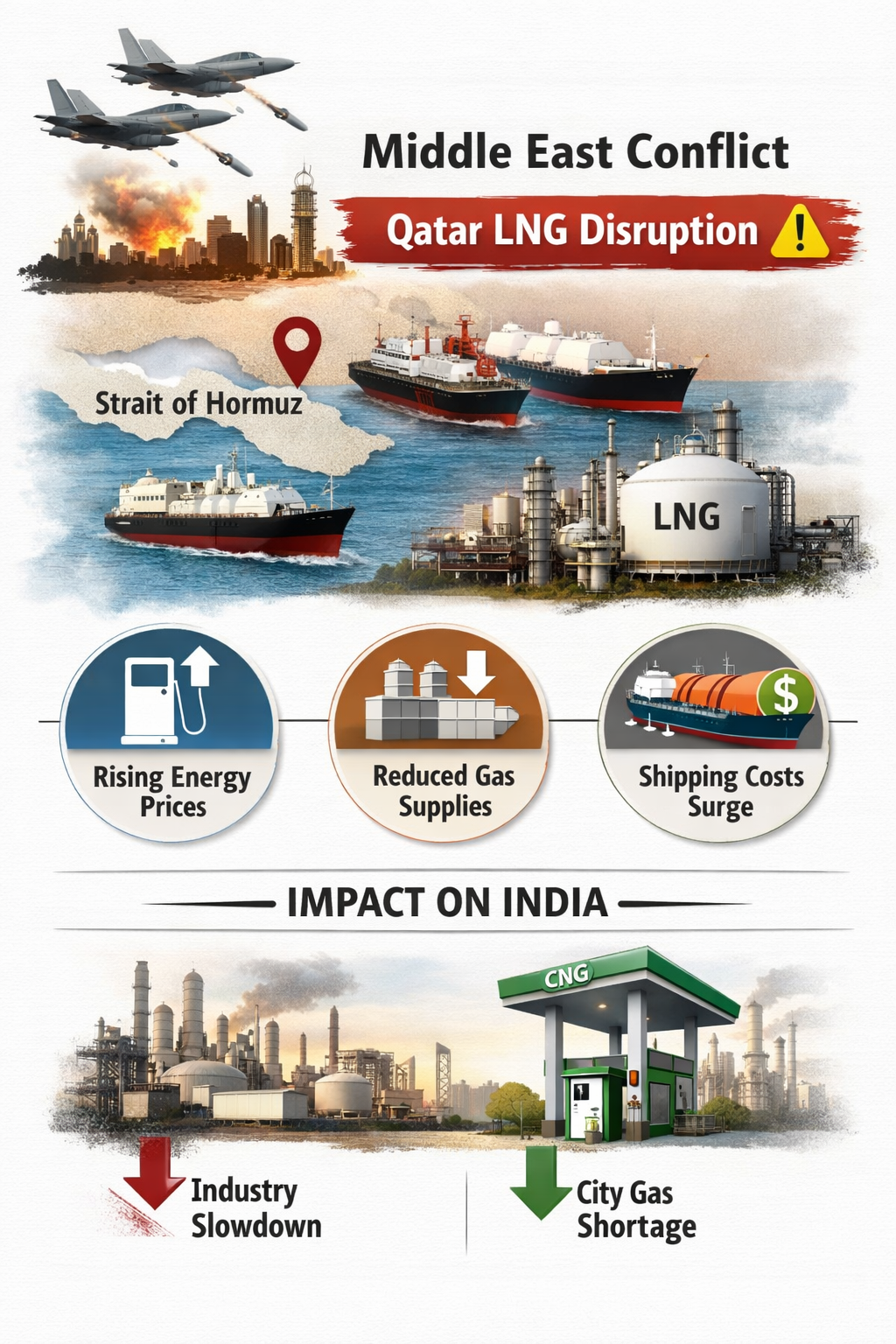
It started with a drone strike. Then missiles. Then, one by one, the lights began flickering across one of the most critical energy corridors on the planet. By Monday morning, Qatar the country that sends nearly half of India’s imported cooking and industrial gas had shut down its entire liquefied natural gas operation. And India, still rubbing its eyes, found itself staring at a supply chain problem it had always feared but never quite prepared for.
This is not just a story about war. It is a story about how deeply India’s energy veins run through the Middle East and what happens when that region catches fire.
The Strait That Controls the Lights
There is a narrow strip of water between Iran and the Arabian Peninsula called the Strait of Hormuz. It is, at its narrowest, just 33 kilometres wide. Yet nearly one-third of the world’s seaborne oil passes through it every single day. For India, this stretch of sea is even more consequential roughly half of the country’s crude oil and more than half of its LNG imports travel through that corridor.
When Iran began striking Gulf states in retaliation for attacks by Israel and the United States, ship captains started making a different calculation. The number of vessels transiting the Strait dropped from about 135 per day in February to just 26 on a single recent day. That is not a slowdown. That is a near-complete halt.
Petronet LNG, India’s largest LNG importer, made the situation official with a blunt stock exchange filing. Its tankers Disha, Raahi, and Aseem could not safely sail to Qatar’s Ras Laffan port to pick up the gas India had already paid for. Both Petronet and Qatar’s state energy giant, QatarEnergy, declared force majeure, a legal term that essentially means: circumstances beyond our control have made it impossible to keep our promises.
40 Per Cent Less Gas, Overnight
The numbers that followed were stark. Supply cuts of between 10 and 40 per cent hit industrial users across India. State-run companies GAIL, Indian Oil Corporation, and Petronet LNG quietly informed their customers late on Monday night that allocations were being trimmed. The cuts were set at what is called “minimum lifting quantities,” a contractual floor designed to protect suppliers from penalty clauses when they cannot deliver.
For factories, fertiliser plants, and power generators that run on natural gas, this was a body blow. Unlike petrol or diesel, gas cannot simply be stored in a drum and pulled out later. It flows through pipes, and when the flow weakens, production weakens with it.
City gas companies the firms that supply CNG to your auto-rickshaw and piped gas to your kitchen are particularly worried. The Association of CGD Entities wrote urgently to GAIL, warning that if spot market LNG had to replace contracted Qatari supplies, the math would turn ugly very quickly. Spot LNG prices have already shot up to around $25 per million British thermal units roughly double what companies pay under long-term contracts. At those prices, CNG stops being the cheap option. Drivers switch to electric vehicles, and the customer base shrinks permanently.
Tanker Rates Double in a Single Day
The disruption has not stopped at gas supply. The shipping market has gone haywire. Charter rates for LNG tankers operating in the Atlantic region crossed $200,000 per day more than double what they were just 24 hours earlier, and more than three times the benchmark rate that was considered normal just days before.
Think about what that means in practice. Every cargo of LNG that India tries to buy on the open market now comes loaded with dramatically higher transport costs, on top of already elevated commodity prices, on top of higher insurance premiums because vessels are sailing into a war zone.
To plug the gap, companies including IOC, GAIL, and Petronet are planning to issue spot tenders basically emergency purchase orders for whoever can supply LNG quickly. But buying in a panic, in a tight market, during an active conflict, is never cheap.
What Comes Next
India’s Oil Minister convened an emergency meeting with the heads of state-run energy companies. The government has signalled that household gas supply will be protected first, with industry and refineries absorbing the worst of any shortfall. Officials are also exploring government-to-government procurement deals to bypass the chaotic spot market.
None of these are long-term answers. They are firefighting measures.
The deeper question, the one India has been kicking down the road for years, is about energy diversity. Qatar alone supplied 40 per cent of India’s annual LNG imports last year. That is a single point of failure of extraordinary consequence. The Middle East as a whole accounts for an even larger share. When that region destabilises, India does not just pay higher prices it faces the prospect of literally running short.
India has been making moves toward US LNG deals and diversifying supply chains, but those contracts take years to materialise and pipelines to build. For now, the country is doing what it always does in a crisis improvising, rationing, and hoping the storm passes quickly.
Whether it does or not, the message from the Strait of Hormuz is now impossible to ignore. India’s energy security has a chokepoint, and that chokepoint is on fire.