There are no items in your cart
Add More
Add More
| Item Details | Price | ||
|---|---|---|---|
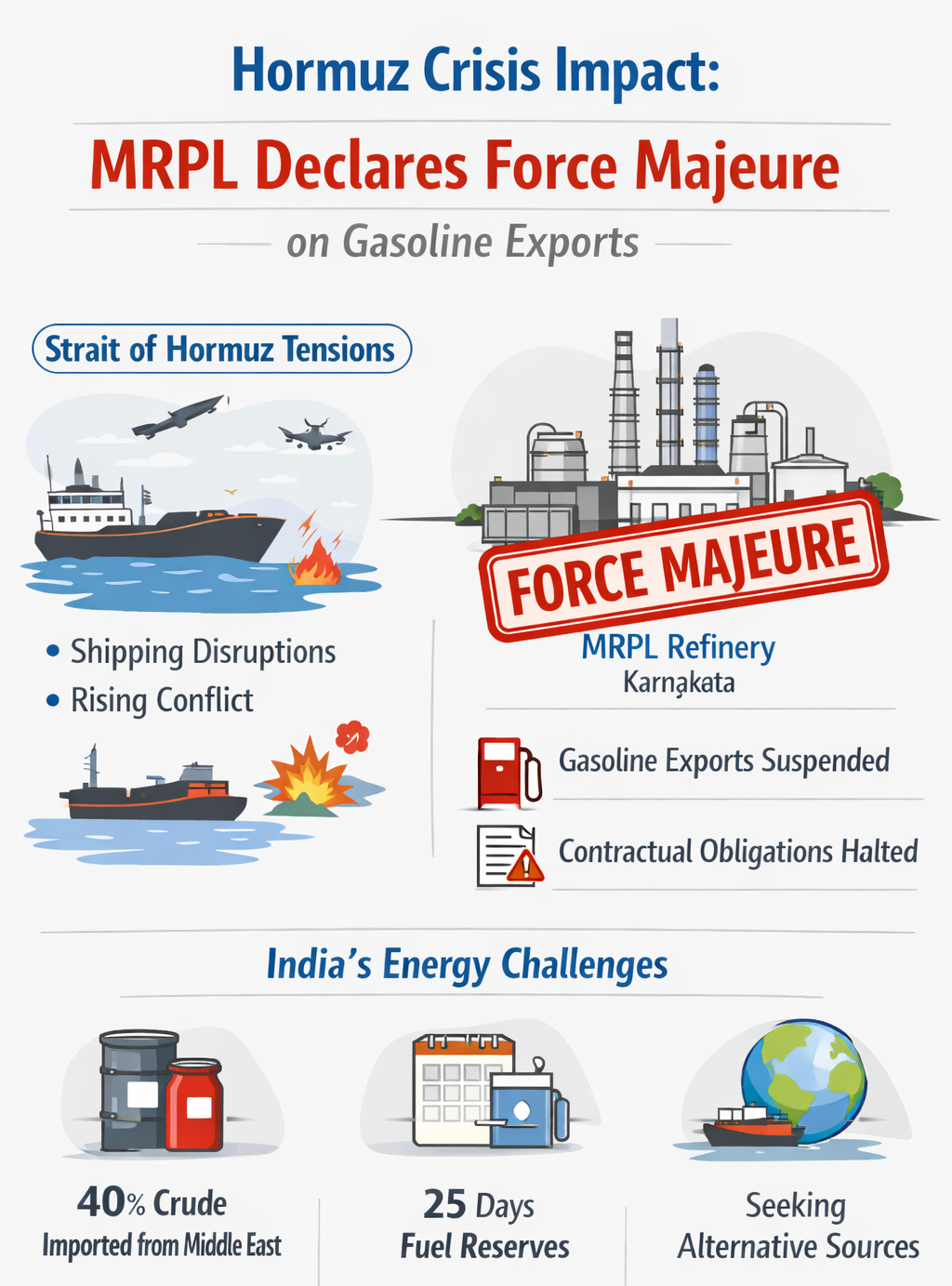
A refinery the size of a small city sits on the coast of Karnataka. Every day, it processes half a million barrels of crude oil and ships fuel to buyers across the world. This week, it stopped. Not because of a breakdown or a strike - but because a waterway thousands of kilometres away has effectively closed. Mangalore Refinery and Petrochemicals Limited, known as MRPL, declared force majeure on March 4. The legal move means the company is formally suspending its commitments to deliver gasoline shipments for March and April, citing circumstances it cannot control. Those circumstances have a name: the Strait of Hormuz.
A Narrow Channel That Feeds the World
The Strait of Hormuz is a strip of ocean barely 33 kilometres wide at its narrowest point, sitting between Iran and Oman. Yet roughly one in every five barrels of oil consumed on the planet passes through it. For India, this channel is not just a trade route - it is a lifeline. Indian refiners source around 40 percent of their crude oil from the Middle East. When that supply chain snaps, the effects are felt almost immediately. Shipping through the strait has "virtually stopped" after Iran's Revolutionary Guard Corps launched missile and drone attacks on vessels passing through the waterway - a response to US and Israeli strikes on Iranian targets.
MRPL: Running on Borrowed Time
MRPL is not a small operation. Its refinery in Karnataka processes 300,000 to 500,000 barrels of crude a day and exports roughly 40 percent of everything it produces. Among its products: gasoline, gasoil, and jet fuel - all of which have now been paused. The company had already secured two or three gasoline cargoes for early March delivery through tenders. Those deals are now in limbo, with MRPL in talks with buyers to figure out how to settle the contracts. The refiner holds crude inventory for only about two weeks - meaning the clock is ticking. MRPL also has swap agreements with oil traders - arrangements where the company receives crude in exchange for refined fuel. That circular trade has now stalled, since neither side can move goods freely.
India Was Already Searching for Alternatives
MRPL's situation did not appear overnight. Back in January, the refiner said it was exploring Venezuelan oil after halting Russian imports to stay compliant with Western sanctions. That search for alternatives now has added urgency. India imports over 80 percent of its crude oil needs. A government source confirmed this week that the country is actively scouting for substitute sources of crude, LPG, and liquefied natural gas. One analyst from IDFC First Bank pointed to Russia as a possible short-term workaround - a route India has leaned on before. For now, India holds crude stocks sufficient for about 25 days of demand. Refined product inventories - covering gasoil, gasoline, and LPG - are at a similar level. That buffer buys time, but not much.
The Ripple: Gas Prices, Supply Cuts, and a Qatar Shutdown
MRPL is far from alone. Across India's energy sector, companies are scrambling to respond to what is fast becoming a broad supply emergency. Qatar - one of the world's top gas exporters - has declared force majeure on its own gas exports, halting production and liquefaction at QatarEnergy facilities. A restart could take up to two weeks, a timeline that will rattle gas markets globally. Petronet LNG, which handles much of India's liquefied natural gas imports, has issued force majeure notices to both its suppliers - including QatarEnergy - and its domestic customers, among them GAIL, Indian Oil, and Bharat Petroleum. Gujarat Gas has announced cuts to industrial customers from March 6. Adani Total Gas has nearly tripled the price of gas consumed above contracted levels, jumping from around Rs 40 to Rs 119 per standard cubic metre. GAIL, India's largest gas distribution company, is reportedly weighing supply restrictions of its own.
Oil Prices Are Already Climbing
Before tensions escalated sharply, crude oil was trading around $72 a barrel. As of this week, prices have surged to near $84 - a jump of nearly 17 percent in a matter of days. For India, which spends tens of billions of dollars annually on energy imports, every dollar increase in crude prices matters. Axis Asset Management noted that rising crude prices raise input costs across the economy, push up the current account deficit, and feed inflation. Industries that feel the pain quickly include aviation, paints, cement, and chemicals - sectors where energy is a major cost component.