There are no items in your cart
Add More
Add More
| Item Details | Price | ||
|---|---|---|---|
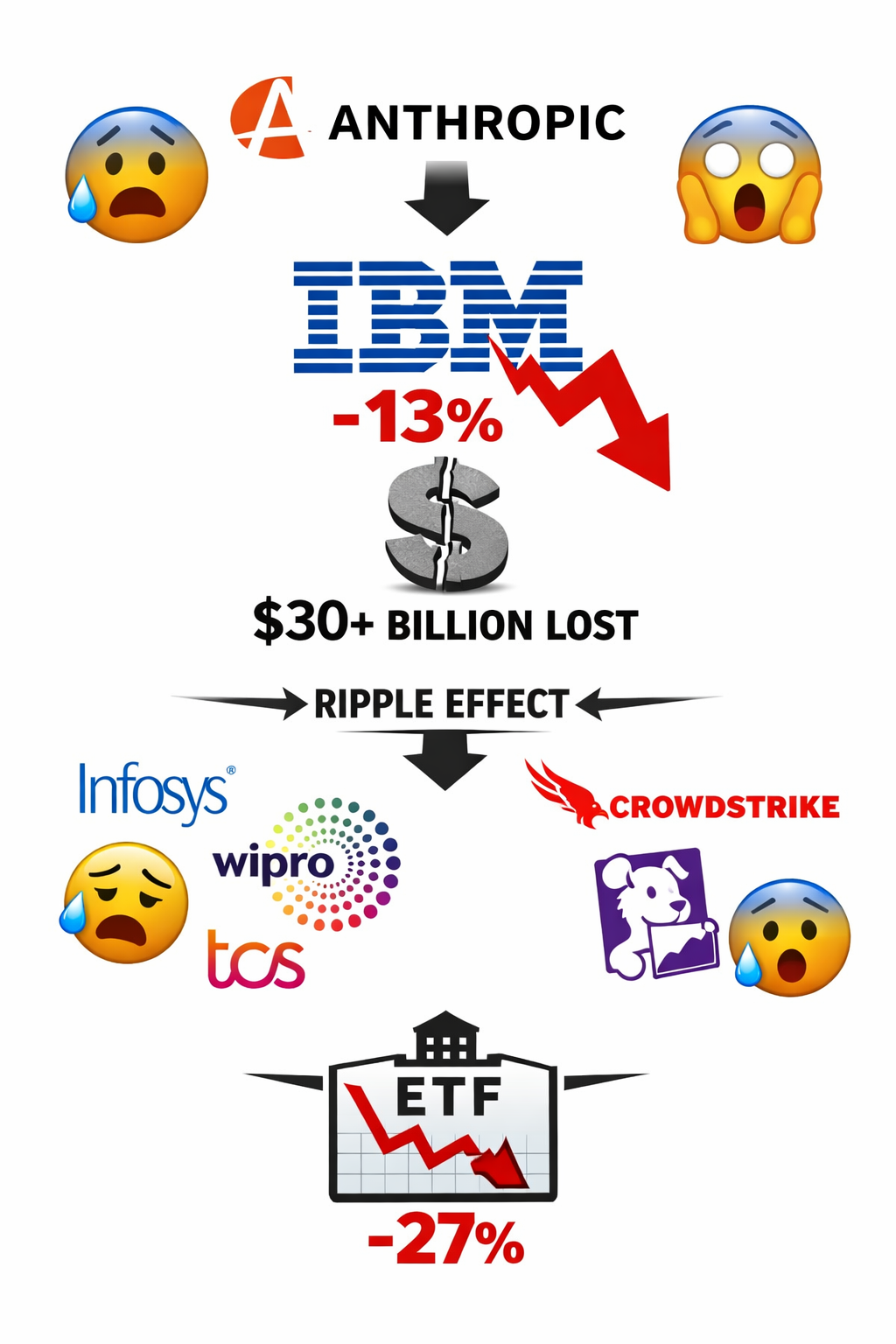
On February 23, 2026, IBM had one of the worst days in its modern history. Its stock fell 13.2% - the biggest single-day drop the company had seen since October 2000. In dollar terms, that one drop wiped out roughly $30 to $40 billion in market value. Investors were shaken. The reason? A blog post
What Did Anthropic Actually Say?
Anthropic makes Claude, one of the most popular AI assistants in the world. On that Monday morning, the company published a blog post about a tool called Claude Code - and what it said sent shockwaves through financial markets. The claim was simple but powerful: Claude Code can now handle the hardest part of modernizing COBOL - an old programming language that still runs inside banks, airlines, insurance companies, and government systems worldwide. Anthropic said its tool can read through thousands of lines of old code, understand how everything connects, flag risks, and help teams rewrite it in a modern language like Java or Python. Tasks that used to take years, they argued, could now be done in a matter of months.
What Is COBOL, and Why Should Anyone Care?
COBOL stands for Common Business-Oriented Language. It was created back in 1959 - yes, over 65 years ago - and was designed to handle business data like payroll, transactions, and records. The surprising thing is that it never really went away. Today, around 95% of ATM transactions in the United States still run on COBOL. About 80% of in-person credit card swipes depend on it too. Hundreds of billions of lines of COBOL code are still active every day, quietly keeping the financial world running. The problem is that fewer and fewer people know how to work with it. Most young developers learn Python or Java - not COBOL. The programmers who do know it are retiring, and not enough new ones are stepping in to replace them. This has made COBOL expertise expensive and hard to find. Organizations that want to update their systems have had to hire large teams of specialized consultants and spend years - sometimes decades - on the process.
Why IBM Specifically Got Hit So Hard
Most of the systems that run COBOL sit on IBM mainframes - massive, powerful computers that IBM has sold to banks and governments for decades. IBM earns money not just from selling these machines, but also from the software licences, services, and consulting contracts that come with keeping them running. In other words, the slow, expensive process of managing and modernizing COBOL has been good business for IBM. When companies want help understanding their old code or carefully moving to newer systems, they often call IBM. Anthropic's announcement threatened to change that equation completely. If an AI tool can do in weeks what consultants used to bill for over years, the demand for those long, expensive contracts could dry up fast. That fear hit IBM's stock hard - and the numbers showed it. IBM shares have fallen around 27% in February alone, putting the company on track for its worst month since at least 1968.
The Ripple Effect Across the Industry
IBM wasn't alone. The sell-off spread quickly to other parts of the tech and IT sector. Indian IT giants like Infosys, Wipro, and TCS also felt the pressure. A significant part of their business involves helping large companies manage and update legacy systems - including COBOL. If AI reduces the need for that work, their revenue models face similar questions. Cybersecurity companies like CrowdStrike and Datadog also saw their stocks dip after Anthropic separately revealed that Claude Code includes security scanning features. Investors started asking the same question across the board: if AI can do this work, who still needs to pay someone else to do it? A major software ETF has now dropped about 27% this year - its steepest quarterly fall since the 2008 financial crisis.
Is the Fear Overblown?
Not everyone agrees that AI will replace IBM's mainframe business overnight. Large banks and government agencies are extremely careful about changing core systems. A mistake in these environments doesn't just mean a software bug - it can mean millions of failed transactions or regulatory fines. IBM itself has been investing heavily in AI through platforms like Watson. The company isn't standing still, and it has decades of trust built with enterprise clients who aren't likely to walk away quickly. There's also a difference between what AI can do in a demo and what holds up across years of undocumented, complicated, real-world code. Legacy systems often contain business logic that nobody fully understands anymore - and that requires careful human judgment, not just automated scanning. Still, markets move on perception. Investors didn't wait to see whether Anthropic's claims would hold at enterprise scale. They sold first and planned to ask questions later.
The Bigger Picture What happened to IBM on February 23 is part of a wider shift in how investors think about the technology industry. The fear is simple: if AI can write, analyze, and transform code - even old, complicated code like COBOL - then the companies that have built entire businesses around doing that work manually are in trouble. This isn't just about IBM. Consulting firms, IT service giants, and enterprise software vendors are all being forced to answer the same question: what do they offer that an AI system can't? Nobody has a full answer yet. But Wall Street is already placing its bets.