There are no items in your cart
Add More
Add More
| Item Details | Price | ||
|---|---|---|---|
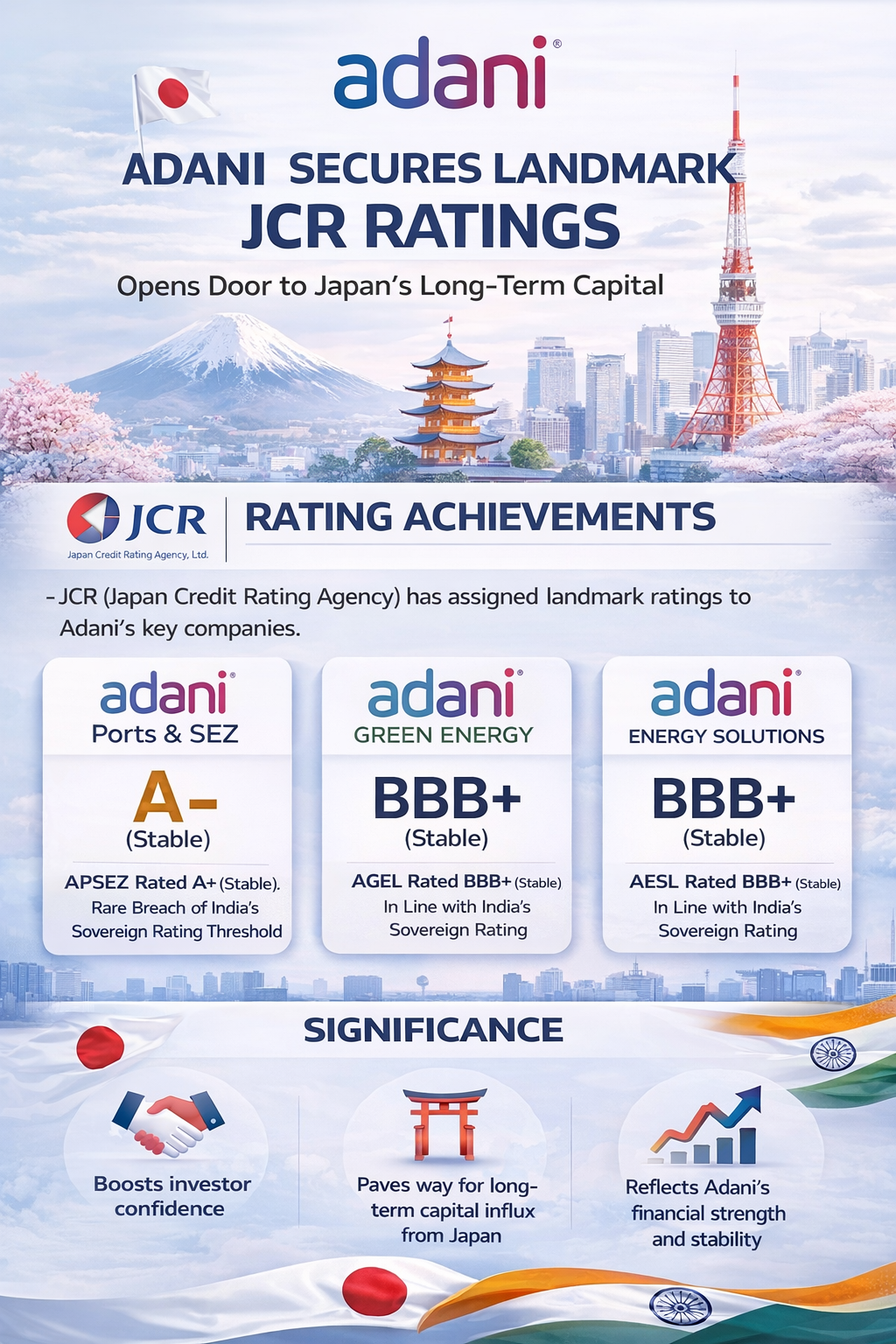
The Adani Group has reached a significant milestone in its global expansion strategy by securing credit ratings from Japan Credit Rating Agency (JCR) for three of its flagship companies. This development opens new avenues for the Indian conglomerate to access Japan's vast debt markets, one of the largest in the world. JCR has assigned long-term foreign currency credit ratings with stable outlooks to Adani Ports & SEZ Ltd (APSEZ), Adani Green Energy Ltd (AGEL), and Adani Energy Solutions Ltd (AESL). The ratings represent a notable achievement for the group as it seeks to diversify its funding sources and strengthen its position in international capital markets.
Breaking Through the Sovereign Ceiling
In a rare distinction for an Indian company, APSEZ received an A- rating with a stable outlook from JCR. This rating places the ports operator above India's sovereign foreign currency rating, a threshold that only a handful of Indian corporations have managed to breach. APSEZ now joins an elite group that includes Reliance Industries, Tata Consultancy Services, and Larsen & Toubro in achieving this status. Meanwhile, AGEL and AESL each received BBB+ ratings with stable outlooks, which align with India's sovereign rating. These assessments reflect the strong fundamentals and growth trajectories of both companies in their respective sectors. Jugeshinder Singh, Group CFO of Adani Group, emphasized that the ratings validate the conglomerate's approach to financial management and infrastructure development. He noted that the assessments demonstrate the confidence that global lenders, institutional investors, and capital markets have in the group's long-term strategy and business model.
Strong Performance Across Key Businesses
The ratings are backed by impressive financial and operational metrics across all three companies. APSEZ operates a network of 15 domestic ports and four international facilities, handling approximately 30 percent of India's cargo and half of its container volumes. The company has shown remarkable growth, with EBITDA increasing from ₹7,566 crore in fiscal year 2020 to ₹19,025 crore in fiscal year 2025. In the first half of the current fiscal year, APSEZ reported EBITDA of ₹11,046 crore while maintaining a conservative net-debt-to-EBITDA ratio of 1.8 times. JCR highlighted APSEZ's stable cash flows from long-term port concessions, robust operational capabilities, and prudent financial management as key factors supporting its rating. The agency noted that the rating is capped only by India's country ceiling, suggesting that the company's fundamentals might otherwise warrant an even higher assessment. AGEL, India's largest independent renewable power producer, operates 16.7 gigawatts of capacity across 12 states. More than 90 percent of its EBITDA comes from renewable energy sources. The company has experienced substantial growth, with EBITDA rising from ₹1,855 crore in fiscal 2020 to ₹10,532 crore in fiscal 2025. This expansion has been supported by long-term power purchase agreements, high plant-load factors, and efficient operations. AESL focuses on electricity transmission, distribution, smart metering, and cooling networks. The company manages 26,705 circuit kilometers of transmission lines and has a capacity of 97,236 MVA. Its smart metering portfolio has grown to 7.37 million meters. AESL's EBITDA increased from ₹4,532 crore in fiscal 2020 to ₹7,747 crore in fiscal 2025, underpinned by a one billion dollar equity raise and a well-structured funding profile.
Gateway to Japanese Capital Markets
The JCR ratings could prove transformative for Adani's funding strategy. While Japanese banks such as MUFG and Mizuho already have lending relationships with the group, these ratings may attract a broader range of Japanese institutional investors, including insurance companies and pension funds. Japan's debt market is one of the largest globally, with government bonds alone exceeding 12 trillion dollars. Japanese investors have consistently shown appetite for infrastructure debt with long maturities, typically ranging from 20 to 30 years. This preference aligns perfectly with the capital-intensive nature of Adani's businesses in ports, power transmission, and renewable energy, which require long-term funding to support their growth plans.
Ambitious Expansion Plans Continue
The ratings arrive as the Adani Group continues to pursue aggressive expansion across its portfolio companies. The conglomerate has outlined plans for approximately 17 billion dollars in capital expenditure this year, part of a broader 100 billion dollar investment program running through 2030. Financial metrics across the group have shown improvement in recent years. EBITDA has more than doubled since fiscal 2022, while net debt has declined relative to earnings despite the elevated capital spending. These trends suggest that the group is managing to grow while maintaining financial discipline. JCR noted that AGEL's predictable revenues from long-term power purchase agreements and AESL's governance structure and funding integration support their credit stability and growth prospects. The agency's assessments indicate that investor focus in some markets is returning to fundamental metrics such as cash flows, asset quality, and balance sheet trends.
Looking Ahead
The JCR ratings mark an important step in the Adani Group's journey to establish itself as a globally recognized infrastructure and energy platform. By securing these ratings, the group has demonstrated its ability to meet international credit standards and has opened doors to new sources of long-term capital. For a conglomerate with ambitious growth plans spanning ports, renewable energy, and power infrastructure, access to diverse funding sources with appropriate tenors is essential. The Japanese debt market, with its size and preference for infrastructure investments, represents a natural fit for Adani's funding requirements as it continues to build out India's infrastructure backbone.
Disclaimer: This article is for informational purposes only and should not be considered as investment advice. Please consult your financial advisor before making any investment decisions. Investments in the market are subject to risks.